Learn How Deep Does Stump Grinding Go for Different Tree Species
How Deep Does Stump Grinding Go for Different Tree Species?
If you have recently had a tree removed, you may wonder, how deep does stump grinding go? Stump grinding typically removes the visible stump and grinds it below the surrounding soil level. The exact depth depends on the stump's size, tree species, root structure, soil conditions, equipment access, and how you plan to use the area afterward.
Different trees can leave very different types of stumps. A mature oak may leave a large, dense stump, while a palm has a different trunk and root structure. Pine trees and other species can also have roots that spread through the surrounding soil. Because of these differences, there is no single grinding depth that applies to every tree.
For homeowners in Odessa and the greater Tampa Bay area, Joel's Pro Tree Services can help homeowners understand what affects stump grinding depth so they can plan for landscaping, lawn restoration, or other property improvements.
Key Takeaways
Stump grinding reduces the remaining stump below the surrounding ground level.
The exact grinding depth varies from one stump to another.
Tree species can affect stump size, wood density, and root characteristics.
Large hardwood stumps may require more grinding work than smaller stumps.
Surface roots may require additional attention when they are accessible.
Stump grinding does not normally remove the entire root system.
The desired depth depends partly on what you plan to do with the area afterward.
A professional evaluation can help determine the appropriate approach for the stump and property.
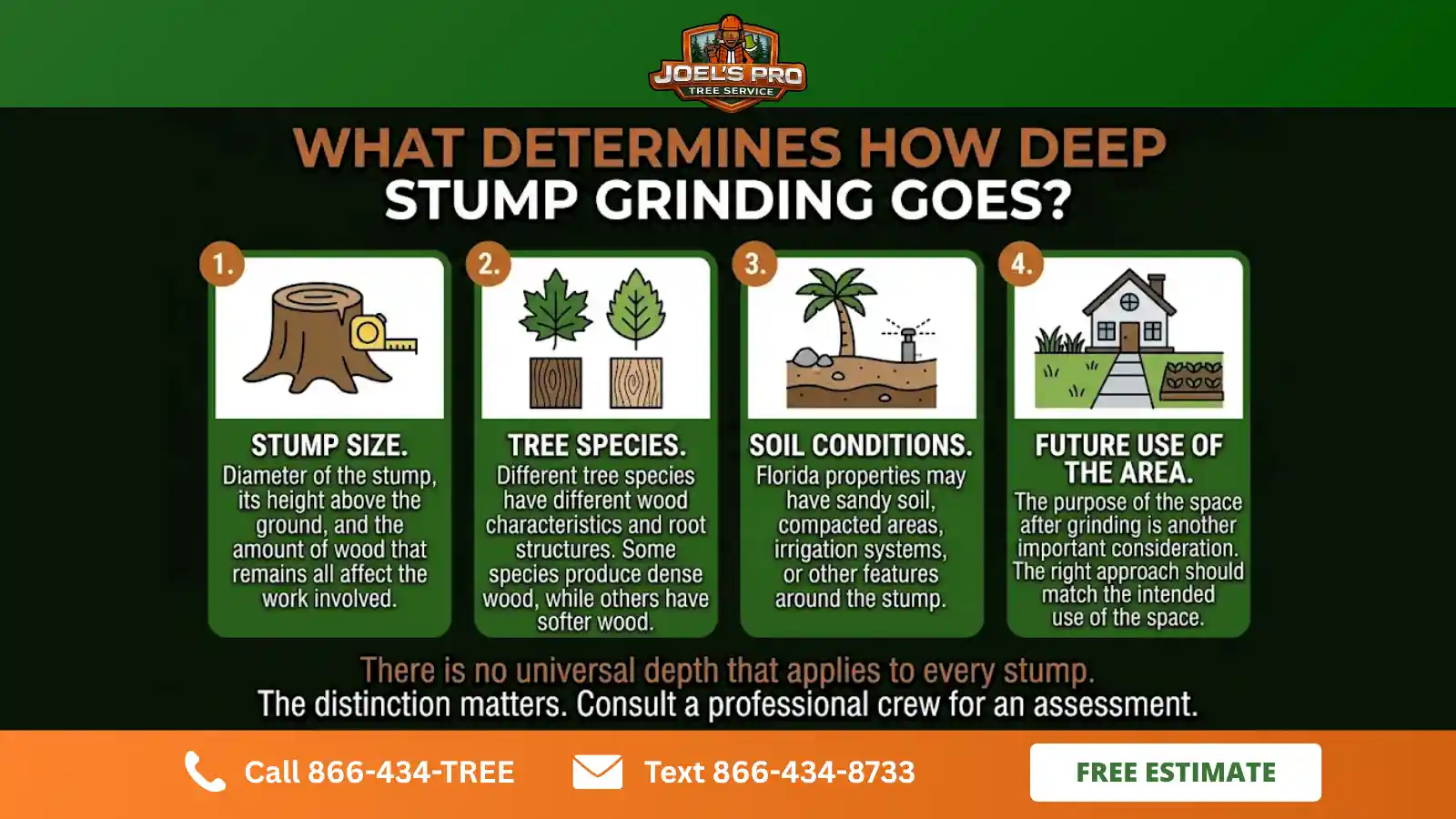
What Determines How Deep Stump Grinding Goes?
There is no universal depth that applies to every stump. Several factors can influence how far below grade a stump is ground.
Stump Size
A larger stump can require more time and grinding passes than a smaller one. The diameter of the stump, its height above the ground, and the amount of wood that remains all affect the work involved.
A small ornamental tree may leave a relatively simple stump, while a mature oak can leave a large, dense stump that requires more grinding.
Tree Species
Different tree species have different wood characteristics and root structures. Some species produce dense wood, while others have softer wood that may be easier to grind.
The root system also matters. Trees with roots that spread close to the surface may leave additional material around the main stump that needs to be considered.
Tree species can help provide an idea of what to expect, but the species alone does not determine the final grinding depth.
Soil Conditions
Soil conditions can affect equipment access and the condition of the surrounding area. Florida properties may have sandy soil, compacted areas, irrigation systems, landscaping, or other features around the stump.
A professional crew needs to consider these conditions before beginning the work.
Future Use of the Area
The purpose of the space after grinding is another important consideration.
If you simply want to restore a lawn, grinding the stump below grade may provide the clearance needed for soil and grass. If you plan to install landscaping, a garden, walkway, or another improvement, the project may require additional preparation.
The right approach should match the intended use of the space.
Schedule Your Tree Service at 866-434-8733
How Deep Does Stump Grinding Go for Oak Trees?
Oak trees are common in Florida, including the Odessa and greater Tampa Bay area. Mature oaks can develop large, dense stumps and extensive root systems.
So, how deep does stump grinding go for an oak? The answer depends on the individual stump and the property's needs rather than the tree species alone.
A large oak stump may require more grinding work because of its size and wood density. Roots extending around the stump may also need to be considered if they are accessible and interfering with the surrounding area.
If the goal is to restore the area for grass or landscaping, the grinding depth can be determined based on the amount of clearance needed for the next stage of the project.
How Deep Does Stump Grinding Go for Palm Trees?
Palm trees have a different structure from many hardwood trees. Their trunks and root systems are not the same as those of trees such as oaks.
Palm stumps can still require professional grinding, particularly when a thick section of trunk remains after removal or when the stump interferes with landscaping.
The appropriate grinding depth depends on the size and condition of the stump, access to the area, and what you plan to do with the space afterward.
It is also important to understand that grinding the remaining palm trunk does not mean every root has been removed. Stump grinding focuses on reducing the remaining stump and accessible material below the surface.
How Deep Does Stump Grinding Go for Pine Trees?
Pine trees are also found throughout Florida and can leave stumps with roots extending through the surrounding soil.
A pine stump can be ground below grade, with the appropriate depth determined by the stump's size, location, condition, and the property's needs.
The condition of the stump can also affect the work. A recently cut stump may differ from one that has already started to decay.
If you plan to replace the lawn or add landscaping, the stump should be ground to a depth that provides suitable clearance for the planned work.
How Deep Does Stump Grinding Go for Maple and Other Broadleaf Trees?
Maples and other broadleaf trees can produce stumps with different root and wood characteristics. Their size and location are often more important to the grinding process than the species name alone.
A smaller stump in an open lawn may be relatively straightforward to grind. A larger stump located near a driveway, structure, irrigation system, or landscaped area may require additional planning.
The objective is to grind enough of the stump below grade to accommodate the property's next use.
Does Stump Grinding Remove the Entire Root System?
No. Stump grinding does not normally remove the entire root system.
The grinding process reduces the remaining stump below the ground surface. Some accessible roots near the stump may also be ground when appropriate.
However, tree roots can extend well beyond the stump. Removing the entire root system would generally require excavation and a different type of work.
This distinction is important when planning landscaping or construction. If your project requires complete removal of the root ball, stump grinding alone may not provide the clearance you need.
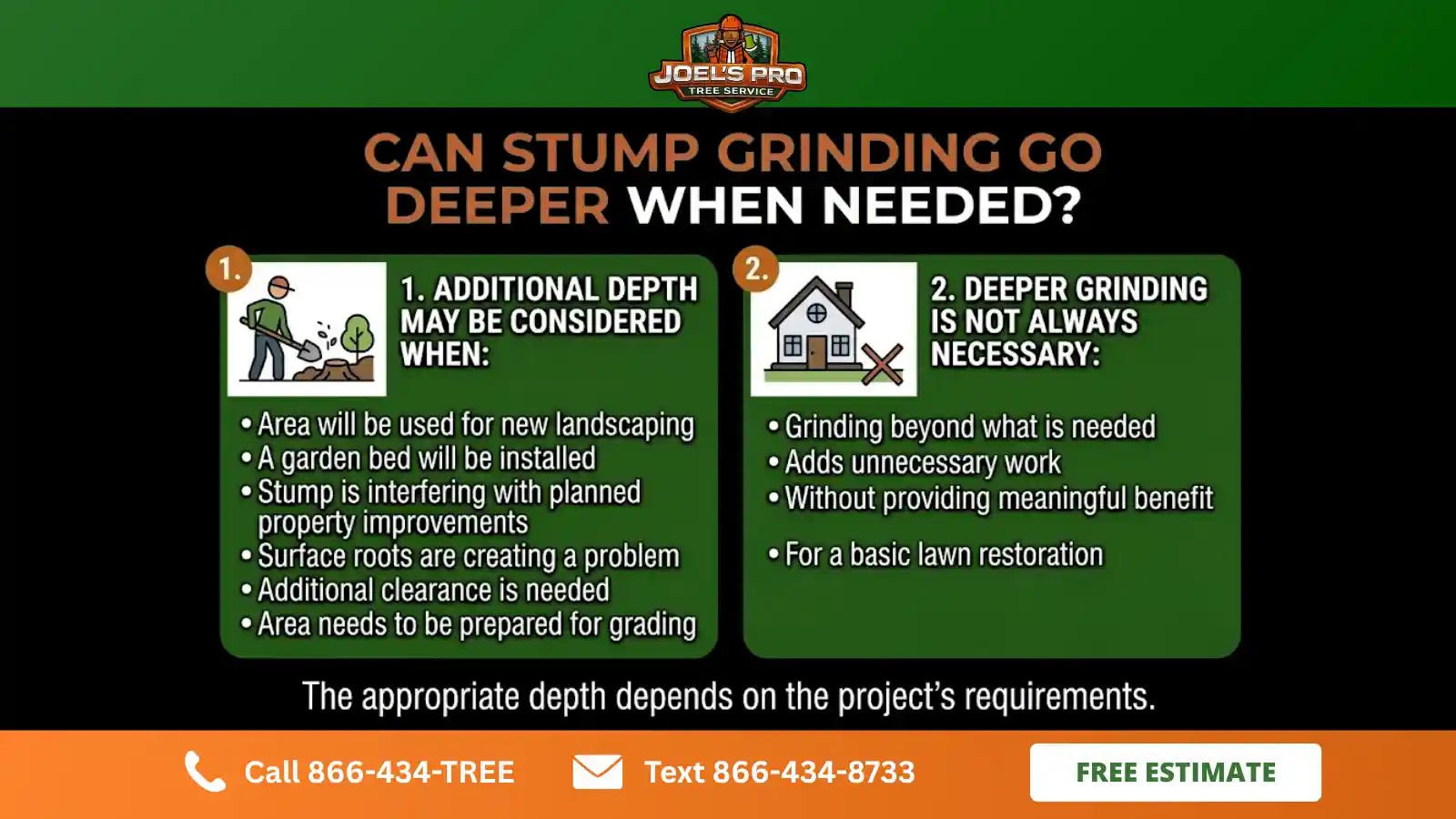
Can Stump Grinding Go Deeper When Needed?
The grinding depth can be adjusted based on the property and the intended use of the area.
Additional depth may be considered when:
The area will be used for new landscaping
A garden bed will be installed
The stump is interfering with planned property improvements
Surface roots are creating a problem
Additional clearance is needed for the next stage of the project
The area needs to be prepared for grading or restoration
However, deeper grinding is not automatically necessary for every stump. The appropriate depth depends on the project's requirements.
Grinding beyond what is needed can add unnecessary work without providing a meaningful benefit for a basic lawn restoration project.
Schedule Your Tree Service at 866-434-8733
Does Tree Species Change the Grinding Depth?
Tree species can influence how a stump grinding project is handled, but there is no fixed grinding depth for every species.
For example, a mature oak may have a larger and denser stump than a smaller ornamental tree. A palm has a different trunk structure, while pine trees can have root systems that spread through the surrounding soil.
The actual stump should be evaluated rather than relying only on its species.
Important factors include:
Stump diameter
Stump height
Wood density
Root structure
Soil conditions
Equipment access
Nearby landscaping or structures
Underground features
Future use of the area
Required finished grade
Considering these factors helps determine a practical grinding approach for the property.
What Happens After the Stump Is Ground?
After grinding, the stump is reduced to wood chips and the surrounding area may contain a mixture of wood material and disturbed soil.
The area may need additional cleanup and backfilling depending on the size of the stump and the property's plans.
For lawn restoration, the space may need suitable soil before grass is planted. For a landscape bed, additional soil and grading may be needed.
Wood material can also settle over time, so proper preparation of the area is important when restoring the ground surface.
Is Stump Grinding Better Than Stump Removal?
The right option depends on the property and what you want to accomplish.
Stump grinding reduces the remaining stump below ground level without requiring excavation of the entire root system. It can be a practical option when the goal is to clear the visible stump and reclaim the surface area.
Complete stump removal involves digging out the stump and a larger portion of its roots. This can disturb more soil and surrounding landscaping and may be appropriate when the entire root mass needs to be removed for a specific project.
A professional tree service can evaluate the stump and property to help determine which approach makes sense.
What About Surface Roots?
Surface roots can become a problem when they grow close to or above the soil surface.
They may create trip hazards, interfere with mowing, or make landscaping more difficult. When accessible, roots around a removed stump may require additional grinding or preparation.
However, roots connected to a living tree should not be cut or damaged without considering the tree's health. If the tree has already been removed, the situation is different, but the surrounding property should still be evaluated before grinding.
Why Professional Stump Grinding Matters in Florida
Florida properties can present specific challenges for tree and stump work. Sandy soil, mature trees, landscaping, irrigation systems, utility lines, fences, driveways, and structures may all be located near the work area.
Equipment also needs enough room to safely reach the stump.
A professional tree service can evaluate access, consider potential obstacles, determine an appropriate grinding approach, and help prepare the area for its next use.
For homeowners in Odessa, Land O' Lakes, Lutz, Trinity, and surrounding Tampa Bay communities, local tree-care experience can be useful when dealing with Florida trees and property conditions.
How Long Does Stump Grinding Take?
The time required depends on the size, condition, and location of the stump.
A smaller stump in an open area may require less time than a large hardwood stump with extensive surface roots or limited equipment access.
The number of stumps also affects the overall project. Multiple stumps require additional equipment positioning, grinding, and cleanup.
Rather than estimating the work based only on tree species, the actual stump and property conditions should be considered.
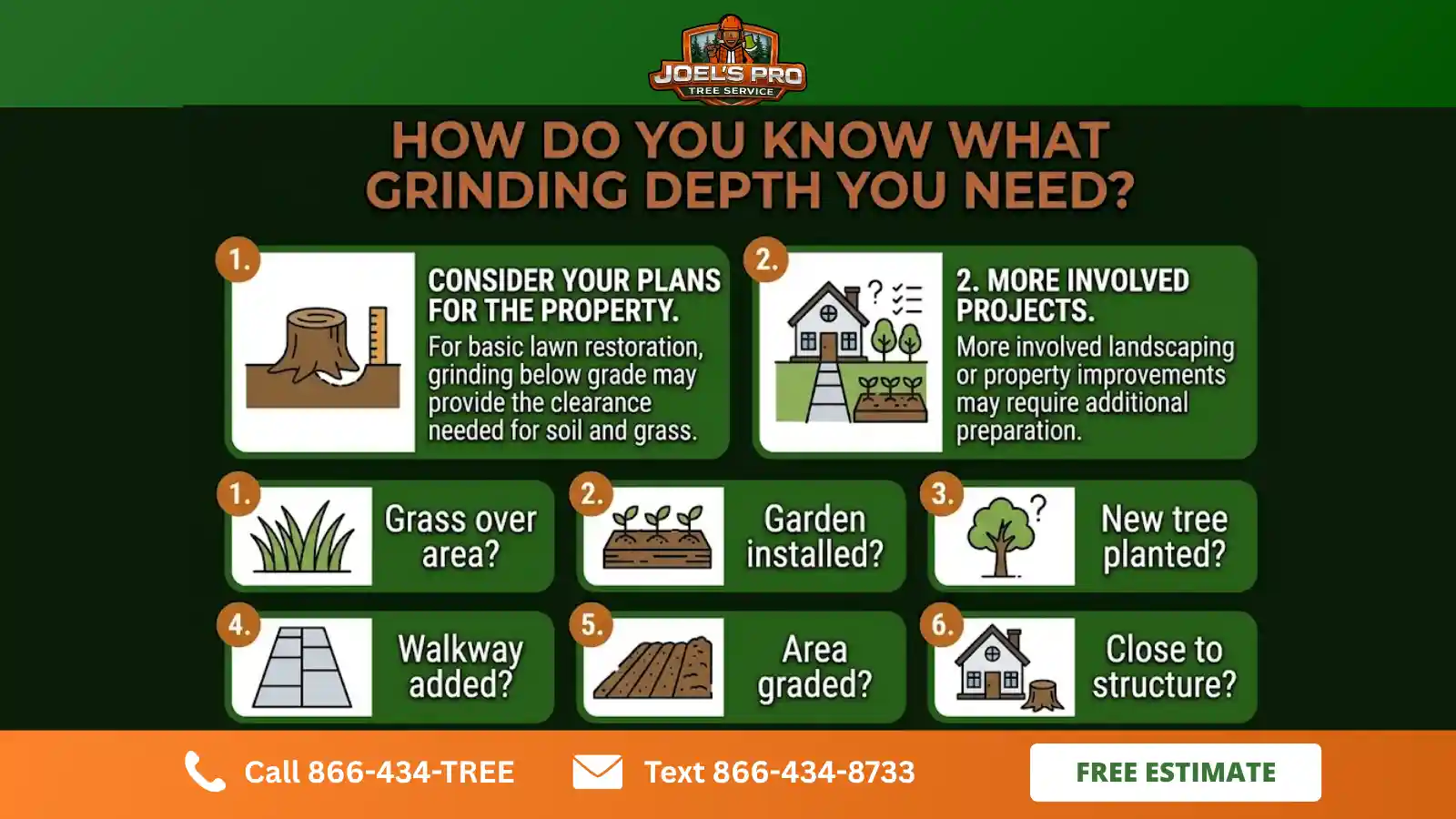
How Do You Know What Grinding Depth You Need?
The best way to determine the appropriate grinding depth is to consider your plans for the property.
Ask yourself:
Will grass be planted over the area?
Will a garden or landscape bed be installed?
Will another tree be planted nearby?
Will a walkway or hardscape be added?
Does the area need to be graded?
Is the stump close to a structure or driveway?
Are surface roots creating a problem?
For basic lawn restoration, grinding below grade may provide the clearance needed for soil and grass. More involved landscaping or property improvements may require additional preparation.
Schedule Your Tree Service at 866-434-8733
Choosing a Stump Grinding Company in Odessa, FL
Joel's Pro Tree Service is a locally owned and operated tree care company serving Odessa, Land O' Lakes, Lutz, Trinity, and the greater Tampa Bay area. The company has served the area since 2017 and provides tree care for local properties.
Its services include tree removal, tree trimming, emergency tree service, stump grinding, land clearing, and plant health care.
The company is licensed and insured and focuses on clear pricing, responsive service, and experienced crews.
When choosing a stump grinding company, look for a professional tree service with appropriate equipment, experienced crews, clear pricing, and a service area that covers your property.
A professional evaluation can also help determine whether standard stump grinding is appropriate or whether additional grinding or site preparation is needed.
Get Professional Stump Grinding in Odessa
So, how deep does stump grinding go? The answer depends on the individual stump, tree characteristics, property conditions, equipment access, and what you plan to do with the area afterward. Stump grinding reduces the remaining stump below ground level, but it does not normally remove the entire root system.
Tree species can affect stump size, wood density, and root characteristics, but there is no single grinding depth for oak, palm, pine, maple, or other trees.
If you have a stump taking up space on your Odessa property, Joel's Pro Tree Service can evaluate the stump and determine an appropriate approach for your property.
Contact Joel's Pro Tree Service today at 866-434-8733 to discuss your stump grinding needs or visit our website.
FREQUENTLY ASKED QUESTIONS
Q: Does stump grinding remove the tree's entire root system?
A: No. Stump grinding reduces the remaining stump below ground level, but roots can extend beyond the stump and generally remain in the soil. If you need a larger area cleared, land clearing may be a better fit depending on the project.
Q: Can surface roots around a removed tree be ground down?
A: Accessible surface roots may sometimes be addressed during stump grinding, depending on their location and the surrounding property. If the tree is still standing, tree trimming or other tree care may be more appropriate than disturbing its roots.
Q: What should I do with the area after a stump is ground?
A: The area may need cleanup, soil, grading, or other preparation before planting grass or landscaping. If additional trees or plants are planned, plant health care can also help support the new landscape.
Q: Does the condition of a stump affect how it is ground?
A: Yes. The stump's size, condition, location, wood characteristics, and equipment access can affect the work. An evaluation helps determine the appropriate approach rather than relying on a fixed depth.
Q: When should I call a tree service after a tree has been damaged or removed?
A: If a tree has been damaged by a storm or creates an immediate property concern, emergency service may be appropriate. For a standing tree that needs to be removed, tree removal can address the larger tree before the remaining stump is handled through stump grinding.
Services We Offer
