Signs You Need Professional Tree Removal Near You | Joel's Tree Service
12 Signs You Need Professional Tree Removal Near You
A tree can look healthy from the street and still have serious structural problems. A cracked trunk, damaged roots, dead limbs, or a sudden lean can change the risk quickly, especially in Florida, where heavy rain and strong storms can put additional stress on trees.
If you're searching for tree removal near you in Clearwater, the first question shouldn't always be, "How much will removal cost?" It should be, "Does this tree actually need to come down?"
Some trees can be preserved with tree trimming, treatment, or monitoring. Others have reached a point where leaving them standing creates an unreasonable risk to your home, vehicles, utility lines, or people using the property.
At Joel’s Pro Tree Service, we evaluate the condition of the tree, its surroundings, and the type of damage before determining whether removal is appropriate.
Key Takeaways
Dead or rapidly declining trees can become increasingly unpredictable as wood loses strength.
Deep trunk cracks, major splits, cavities, and severe decay can indicate structural failure.
A sudden lean or lifted root plate may point to a compromised root system.
Storm damage can expose problems that were not visible before the storm.
Not every damaged or diseased tree needs to be removed; some can be managed through pruning or treatment.
Trees near homes, driveways, power lines, and other structures require extra care because the consequences of failure can be much greater.
12 Signs You May Need Professional Tree Removal Near You
1. The Tree Is Dead or Rapidly Dying
A dead tree is not simply an unattractive part of your landscape. As standing wood dries out and deteriorates, branches can become brittle and more likely to break.
Look for:
Large areas of dead branches
Bare limbs during the growing season
Significant canopy dieback
Peeling or missing bark
Branches that appear dry or brittle
Little to no new growth where healthy growth would normally be expected
A few dead branches don't automatically mean the entire tree needs to be removed. Sometimes deadwood can be safely pruned.
The concern becomes greater when decline affects major limbs, the trunk, or a large portion of the canopy.
2. The Trunk Has Deep Cracks or Major Splits
The trunk carries much of the tree's structural load. Deep vertical cracks, major seams, or significant splits can compromise that structure.
Pay particular attention to cracks around:
Major branch unions
The lower trunk
Areas with previous storm damage
Large cavities
V-shaped branch connections
A tree with a superficial bark crack may not have the same risk as one with a deep structural split. Determining the difference requires looking beyond the surface.
If a major trunk defect is combined with a heavy canopy or a target such as a house or driveway underneath, professional evaluation becomes especially important.
3. The Tree Is Leaning More Than It Used To
Trees don't have to stand perfectly straight to be healthy. Some naturally grow at an angle.
The warning sign is a new or worsening lean.
A sudden change in the tree's angle can indicate root or soil instability. This can become more concerning after periods of heavy rain when saturated soil reduces the stability of the root system.
Check the area around the base for:
Raised soil
Cracking ground
Exposed roots
A lifted root plate
Soil movement
A trunk angle that has changed recently
A leaning tree should not automatically be treated as a removal candidate, but a new lean deserves professional attention.
4. The Roots Are Damaged or Exposed
Roots function as the tree's anchoring system. Damage from excavation, construction, erosion, decay, or soil movement can affect stability.
Look around the root flare for:
Severed roots
Crushed roots
Significant erosion
Exposed root mats
Fungal growth
Soil lifting
Changes in the ground around the trunk
Root problems can be difficult for homeowners to identify because much of the root system is underground.
This is one reason a tree that looks fine above ground may still require an evaluation.
5. Large Limbs Are Dead, Broken, or Hanging
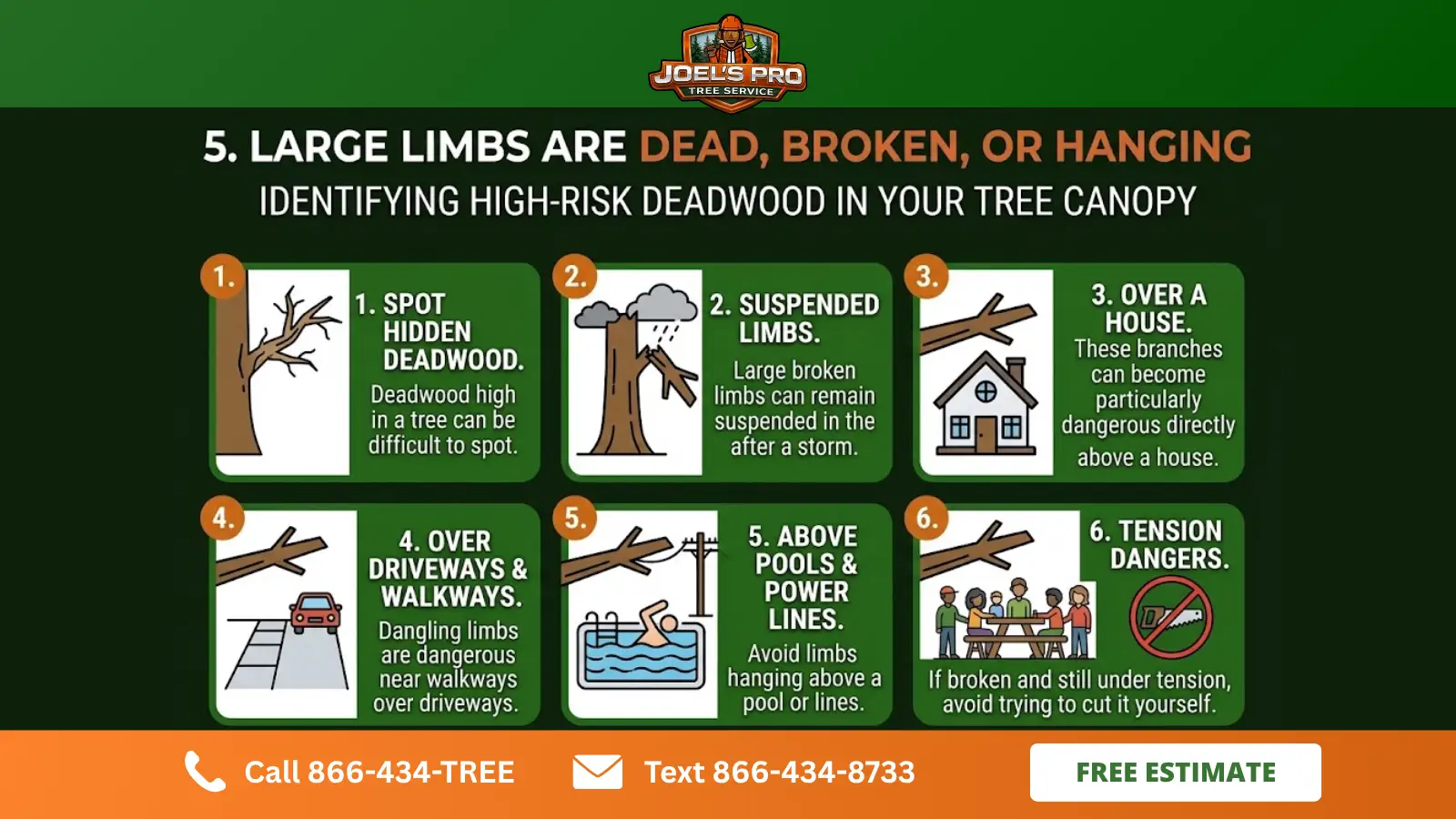
Deadwood high in a tree can be difficult to spot from the ground. Large broken limbs can also remain suspended in the canopy after a storm.
These branches can become particularly dangerous when they are:
Directly above a house
Over a driveway
Near a walkway
Above a pool
Close to power lines
Hanging over an area where people regularly gather
A small dead branch and a large suspended limb are very different problems.
If a large branch is broken and still under tension, avoid trying to cut it yourself. The limb can move unexpectedly when the pressure changes.
Professional crews have the equipment and experience to manage hazardous branches without putting homeowners in the cutting zone.
Schedule Your Tree Service at 866-434-8733
6. The Tree Has Significant Storm Damage
Florida weather can put considerable stress on trees. Strong winds can break major limbs, split trunks, and pull root systems from saturated soil.
After a major storm, look for:
Newly leaning trees
Broken main branches
Split trunks
Hanging limbs
Exposed roots
Lifted root plates
Large sections of missing canopy
Fresh cracks in the trunk
Storm damage does not always mean the tree must be removed.
A tree that loses a few smaller branches may recover with proper pruning. A tree with a split main stem, severely damaged roots, or extensive structural loss may be a different situation.
The important part is having the damage evaluated before attempting cleanup yourself.
7. You See a Large Cavity or Hollow Area in the Trunk
Hollows and cavities can develop as decay progresses inside a tree.
The outside of a tree can sometimes remain green and leafy even while internal wood is deteriorating. That's why canopy appearance alone isn't enough to determine whether a tree is structurally sound.
A large cavity is particularly concerning when it occurs near the base of the trunk or is accompanied by:
Cracks
Fungal growth
Soft or decayed wood
Major branch unions
Leaning
Extensive canopy decline
The presence of a cavity doesn't automatically mean removal is necessary. Its size, location, surrounding wood, and overall tree structure all matter.
8. You Notice Mushrooms or Decay Around the Root Flare
Fungal growth around the base of a tree can be a sign that decay is occurring in the wood or root system.
Look for unusual:
Mushroom clusters
Conks
Soft wood
Decaying bark
Sawdust-like material
Areas that appear to be breaking down around the root flare
Fungi are not enough by themselves to determine whether a tree is unsafe. But when fungal growth appears alongside root damage, cavities, declining canopy health, or instability, it deserves closer inspection.
9. The Tree Shows Signs of Serious Pest Damage
Florida trees can experience pest problems that affect their health and structure.
Potential warning signs include:
Peeling bark
Unusual holes
Sawdust-like material or frass
Rapid canopy decline
Dead branches
Changes in foliage
Visible insect activity
Early pest problems may sometimes be addressed through treatment or other tree-care measures.
The situation changes when pest damage has contributed to extensive decay or structural weakness. At that point, removal may need to be considered alongside treatment of surrounding trees.
10. Major Branch Unions Are Splitting
Where two large branches meet, the shape and structure of the union matter.
V-shaped unions, included bark, and visible splitting can create areas of concentrated structural stress. If a major union begins separating, the affected limb can become a serious hazard.
Watch for:
Fresh cracks
Bark separation
Splits extending downward
Large limbs pulling apart
Previous storm damage around the union
A tree with one questionable branch may only need corrective pruning. A major split involving the trunk or multiple primary limbs requires a more thorough assessment.
11. The Tree Is Too Close to a Valuable Target
Tree condition is only part of the risk equation.
A structurally compromised tree standing in an open field presents a different situation from a similarly damaged tree standing directly over a house.
Consider what is within the tree's potential fall zone:
Homes
Garages
Cars
Driveways
Fences
Pools
Walkways
Outdoor living areas
Utility lines
The closer a defective tree is to something valuable or frequently occupied, the more important a professional assessment becomes.
Sometimes the appropriate solution is removal. In other cases, reducing a hazardous limb or correcting the canopy may address the problem.
12. The Tree Has Multiple Warning Signs at Once
One warning sign does not necessarily tell the whole story.
A tree may have a manageable defect that can be corrected through pruning. But several problems occurring together can change the assessment.
For example, a tree that has:
A new lean
Root lifting
Significant canopy loss
A trunk crack
Dead major limbs
deserves much more attention than a tree with one small dead branch.
Looking at the combination of defects is important because tree safety is rarely determined by one visual symptom alone.
When Should You Choose Tree Removal Instead of Tree Trimming?
This is one of the most important questions to ask before hiring a tree service.
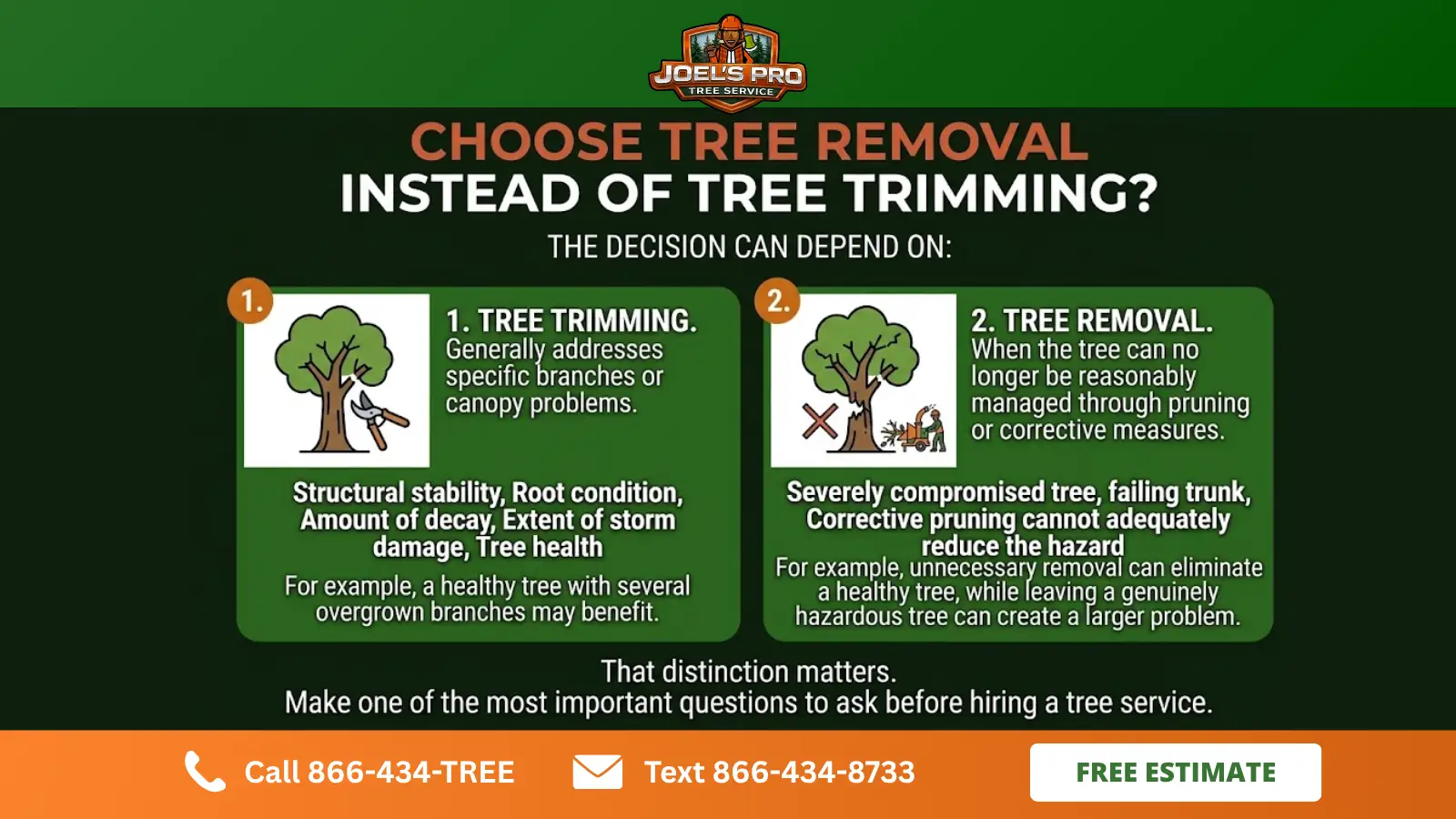
Tree trimming is generally intended to address specific branches or canopy problems while keeping the tree standing. Tree removal is considered when the tree, or a major portion of it, can no longer be reasonably managed through pruning or other corrective measures.
The decision can depend on:
Structural stability
Root condition
Amount of decay
Extent of storm damage
Tree health
Location of the tree
Potential targets below
Whether corrective pruning can adequately reduce the hazard
For example, a healthy tree with several overgrown branches may benefit from trimming. A severely compromised tree with a failing trunk may not.
That distinction matters because unnecessary removal can eliminate a healthy tree, while leaving a genuinely hazardous tree standing can create a much larger problem.
Schedule Your Tree Service at 866-434-8733
Can a Damaged Tree Be Saved Instead of Removed?
Yes. Damage does not automatically mean removal.
Trees can sometimes be preserved through corrective pruning, pest management, plant health care, monitoring, or other treatment when the underlying structure remains sufficiently sound.
A professional assessment should consider the severity of the damage, the condition of the main trunk and scaffold limbs, root stability, overall vigor, and what the tree could threaten if it failed.
At Joel’s Pro Tree Service, our goal is not to recommend removal simply because a tree has a problem. The right solution depends on the condition of the tree and the situation around it.
Why Florida Homeowners Should Pay Attention After Heavy Storms
Storms can change a tree's condition quickly.
Wind can break branches. Saturated soil can affect root stability. A tree that appeared stable before a storm may develop a lean or structural crack afterward.
That is why a post-storm inspection should include more than simply looking for branches on the ground.
Check for changes around the trunk and root flare, hanging branches, major splits, exposed roots, and sections of canopy that have been damaged.
If a large tree has shifted or sustained major structural damage, stay clear of the affected area and arrange a professional assessment rather than attempting dangerous cleanup yourself.
What Happens During a Professional Tree Removal Assessment?
A professional assessment should look at the entire situation rather than focusing on one obvious defect.
That can include examining:
The trunk for cracks, cavities, decay, and structural damage.
The root flare for instability, decay, lifting, or exposed roots.
The canopy for deadwood, broken limbs, and significant dieback.
The branch unions for splits and structural weaknesses.
The surrounding property for homes, vehicles, power lines, driveways, and other targets.
Recent weather conditions that may have changed the tree's stability.
Possible alternatives to removal such as pruning or plant health care.
The goal is to understand both the tree and the consequences if part or all of it fails.
Why Professional Tree Removal Matters
Tree removal is not simply a matter of cutting through the trunk.
Large trees can be heavy, unpredictable, and difficult to control. A poorly planned cut can send a limb or trunk section toward a structure, utility line, vehicle, or person.
Professional removal involves evaluating the tree, planning how sections will come down, managing the work area, and using appropriate equipment.
Afterward, homeowners may also need stump grinding if they want the remaining stump removed below grade.
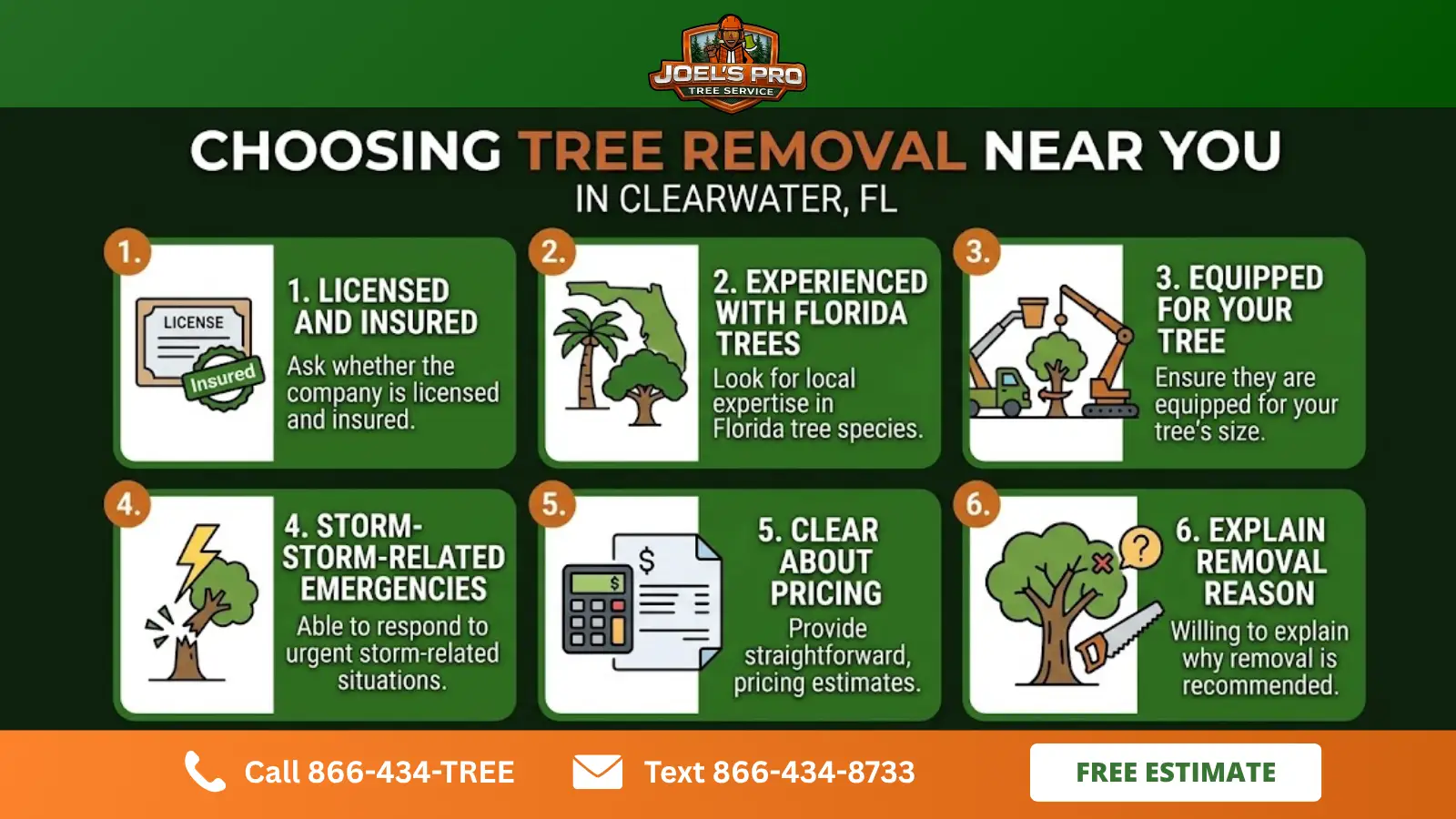
Choosing Tree Removal Near You in Clearwater, FL
When comparing local tree services, look beyond the price of removal.
Ask whether the company is:
Licensed and insured
Experienced with Florida trees
Equipped for the size and location of your tree
Able to respond to storm-related emergencies
Clear about pricing
Willing to explain why removal is recommended
Able to discuss alternatives when removal isn't necessary
Joel’s Pro Tree Service has served Florida homeowners since 2017. The company is locally owned and operated and provides tree removal, tree trimming, emergency service, stump grinding, land clearing, and plant health care.
The team serves Clearwater and communities throughout the greater Tampa Bay area, with an emphasis on straightforward pricing, experienced crews, and responsive service.
Schedule Your Tree Service at 866-434-8733
Frequently Asked Questions
Q: How do I know if I need tree removal near you?
A: Signs that may warrant professional tree removal evaluation include a newly leaning tree, major trunk cracks or splits, extensive decay, severe root damage, large dead limbs, substantial storm damage, or a tree that poses a significant risk to nearby structures. A professional assessment is needed to determine whether removal is actually necessary.
Q: Does a leaning tree always need to be removed?
A: No. Some trees naturally grow at an angle and may remain stable for years. A new or worsening lean, especially when combined with root lifting, soil movement, cracks, or storm damage, is more concerning and should be evaluated.
Q: Can a diseased tree be saved?
A: Sometimes. Depending on the disease, extent of damage, tree structure, and overall health, treatment or pruning may be possible. Removal becomes a consideration when disease or decay has significantly compromised structural stability.
Q: Should I remove a tree after a hurricane or severe storm?
A: Not necessarily. Some storm-damaged trees can recover after appropriate pruning. However, major trunk splits, extensive canopy loss, lifted root plates, sudden leaning, and large hanging limbs should be professionally assessed before cleanup begins.
Q: Is tree removal better than tree trimming?
A: Neither service is automatically better. Trimming addresses specific branches or canopy problems while preserving the tree. Removal is considered when structural defects, decay, root damage, or other conditions make keeping the tree standing unsafe or impractical.
Q: What other tree services does Joel’s Pro Tree Service provide?
A: Joel’s Pro Tree Service provides tree removal, tree trimming, emergency tree service, stump grinding, land clearing, and plant health care.
When It's Time to Have a Tree Evaluated
A dangerous tree does not always announce itself with a dramatic crack or a fallen branch. Sometimes the warning is a gradual lean, thinning canopy, root disturbance, or decay that becomes visible only after a storm.
If you're seeing several warning signs at once, don't wait for the next major weather event to make the decision for you.
Joel’s Pro Tree Service provides tree removal and other tree care services for homeowners in Clearwater and the greater Tampa Bay area. Contact us at 866-434-TREE for a free estimate.
Services We Offer
